How it works
- Open 02 Setup. Check the weights, the point bands, the class limits and the thresholds for value and supply risk. They follow the Starter Kit Guide.
- List your key suppliers in 03 Suppliers with volume, approved sources and supply risk. Share and segment calculate.
- Every month, add one row per supplier in 04 Scorecard with ppm, on-time in-full and the two ratings. Points, total and class calculate.
- Record every complaint in 05 Complaints. Enter the dates when D3, D4 and D8 are done. Deadlines and status calculate.
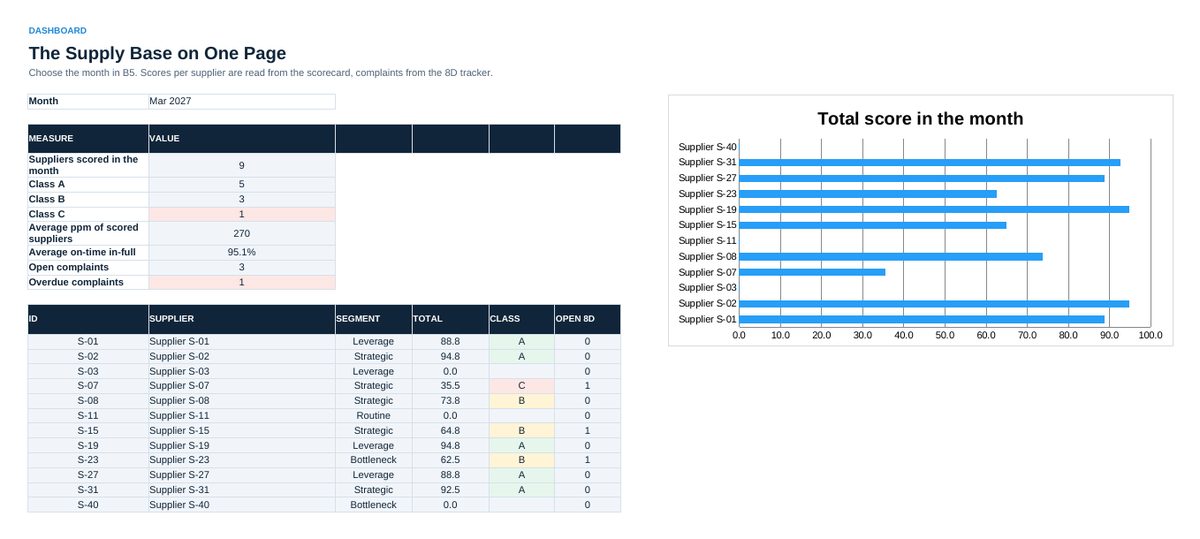
- Read 06 Dashboard in the monthly supplier performance meeting. Record decisions and actions in 07 Actions.
Definitions used in the workbook
- ppm: Rejected parts per million delivered parts in the month: rejected quantity divided by delivered quantity, times 1,000,000.
- On-time in-full: Share of order lines delivered within the agreed window and in the full quantity.
- Segment: Strategic: high value and high supply risk. Bottleneck: high risk, low value. Leverage: high value, low risk. Routine: low value, low risk.
- Class: A from 80 points, B from 60 points, C below 60 points.
Sheets in the workbook
- Start
- Setup
- Suppliers
- Scorecard
- Complaints
- Dashboard
- Actions
Who it is for
Purchasing and supplier quality engineers.
The method behind the numbers
This workbook is part of the Supplier Management toolkits. The Starter Kit adds the guide and the checklist for the first 30 days. The Excellence Bundle adds playbook, workshop pack, templates, deck and the complete Excel system.