How it works
- Open 06 Lists and name your stations. One station per operator position.
- Enter shift time, breaks, planned stops, shifts and customer demand in 02 Takt. Takt and planned cycle time calculate.
- In 03 Observation, list the elements of each station in order, choose the type and enter ten timed cycles in seconds.
- Check the spread. Elements marked Check vary too much: find the cause and observe again before you balance.
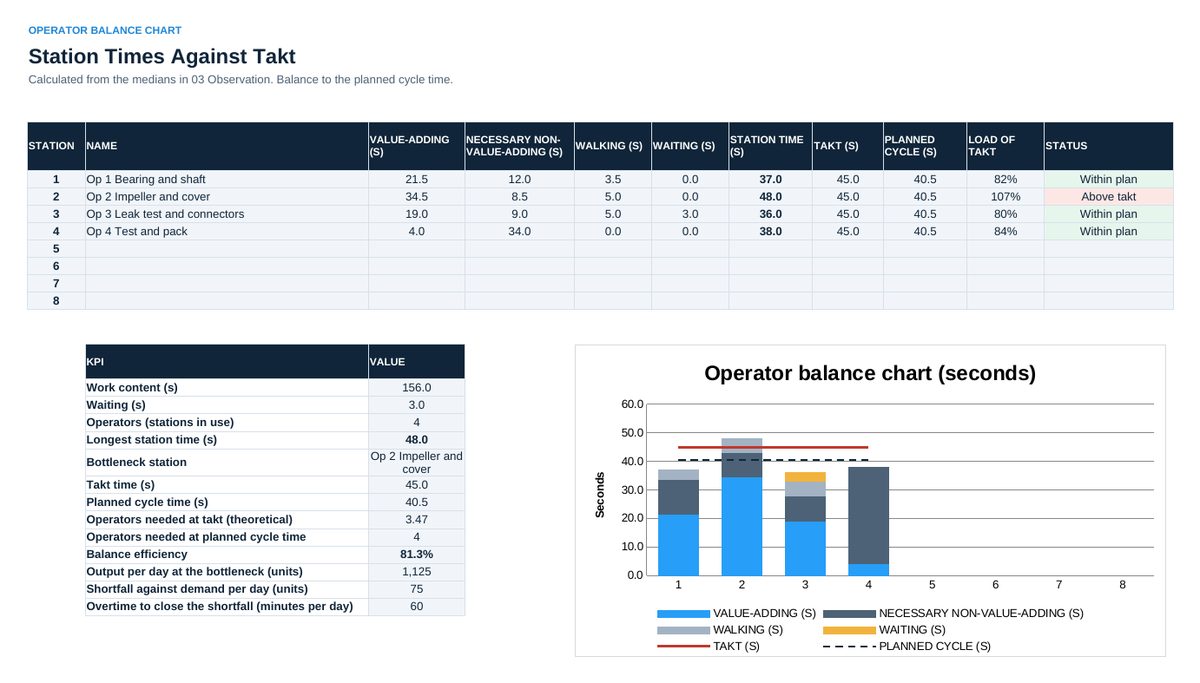
- Read 04 Balance: one stacked bar per station against takt and planned cycle time, with the bottleneck and the cost of the imbalance.
- Move elements on paper, enter the new station numbers in 03 Observation and see the new balance. Agree actions in 05 Action Plan.
Definitions used in the workbook
- Takt time: Available time per day in seconds divided by customer demand per day.
- Planned cycle time: Takt time times the planning factor. Balance stations to this value, not to takt.
- Median: The middle value of the sorted observations. Used as the element time because one bad cycle does not move it.
- Spread: Largest minus smallest observation, divided by the median. Above the limit in 06 Lists the element is marked Check.
- Work content: Sum of all station times without waiting.
- Balance efficiency: Work content divided by number of operators times the longest station time.
Sheets in the workbook
- Start
- Takt
- Observation
- Balance
- Action Plan
- Lists
Who it is for
Industrial engineers and team leaders who set up or improve standard work.
The method behind the numbers
This workbook is part of the Standard Work toolkits. The Starter Kit adds the guide and the checklist for the first 30 days. The Excellence Bundle adds playbook, workshop pack, templates, deck and the complete Excel system.