How it works
- 02 Setup: report date, targets and lists. 03 Register: every change with class, reason and four dates.
- 04 Evaluation: six dimensions, cost and earliest date for one change. 05 Board: the decision record of the weekly meeting.
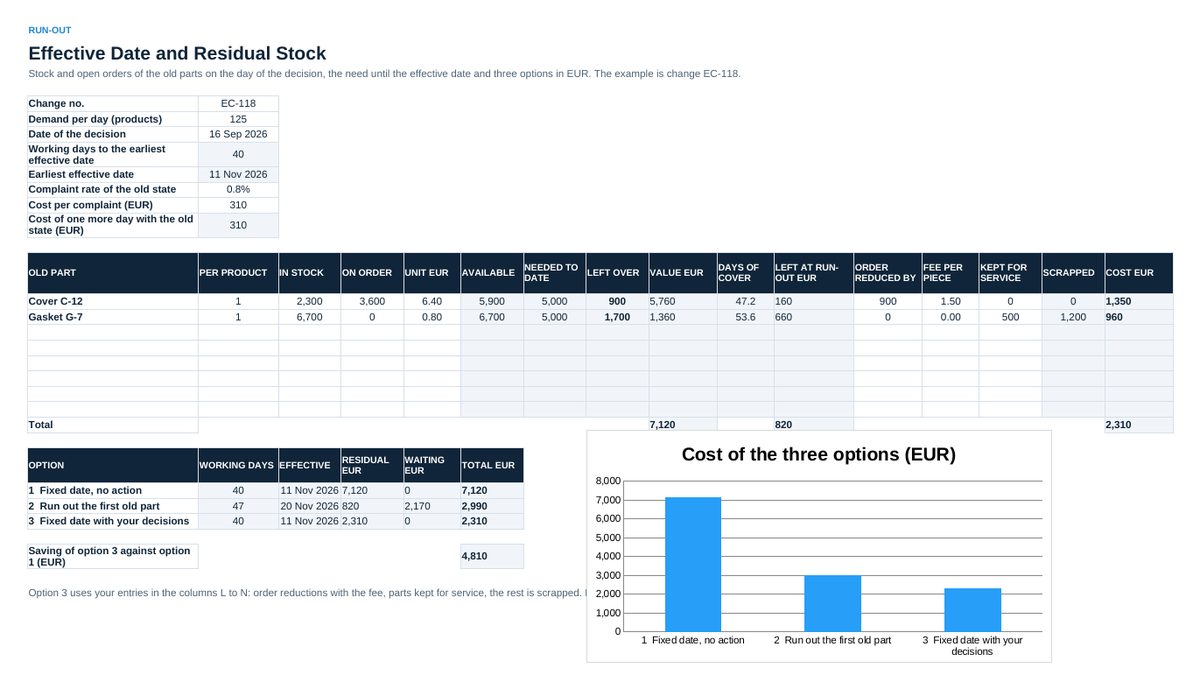
- 06 Run-Out: stock and orders of the old parts and three options in EUR. 07 Documents: every document and data record with owner and date.
- 08 Part Approval: measured samples against the limits. 09 Supplier Changes: process and supplier changes, announced or not.
- 10 Key Figures and 11 Trend: speed and quality of the process over time.
- 12 Audit every three to six months. 13 Status every month.
Definitions used in the workbook
- Change: Every planned change to something that was released: a document, a part, a process, a tool or a source of supply.
- Classes: A: form, fit, function or customer affected. B: process, tool, source or supplier. C: documents only.
- Rush change: A change introduced before evaluation and decision.
- Lead time: Working days from the request to the closure, Monday to Friday. Plant holidays are not counted.
- Effectivity: The rule that says from when the new state applies: a fixed date, the run-out of the old parts, or immediately.
Sheets in the workbook
- Start
- Setup
- Register
- Evaluation
- Board
- Run-Out
- Documents
- Part Approval
- Supplier Changes
- Key Figures
- Trend
- Audit
- Status
Who it is for
Change coordinators and plant managers who steer changes from the request to the approved part.
The method behind the numbers
This workbook is part of the Engineering Change and Part Approval toolkits. The Starter Kit adds the guide and the checklist for the first 30 days. The Excellence Bundle adds playbook, workshop pack, templates, deck and the complete Excel system.