How it works
- 02 Setup and 03 Suppliers: the area and the volume, then every supplier with its record and its switching state.
- 04 Parts: every part in a risk class with its plan, its effort and its trace level.
- 05 Sampling: what each plan accepts, with the curve. Write the two percentages on every plan card.
- 06 Receipt Record and 07 Blocked Stock: every receipt, every blocked lot and the decision with its cost.
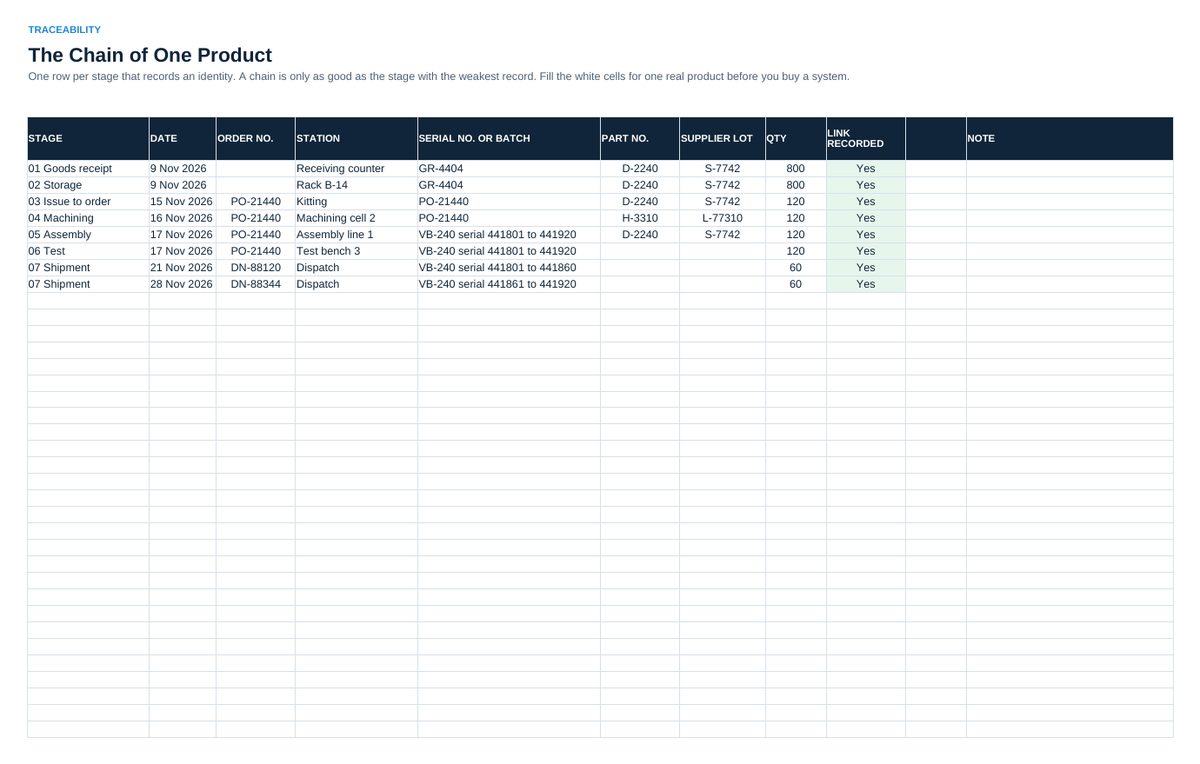
- 08 Traceability and 09 Trace Drill: the chain of one product, and the timed drill in both directions.
- 10 Effort and 11 Business Case: where the hours go before and after, and what the change pays.
- 12 Trend weekly, 13 Audit every three months, 14 Status at the board.
Definitions used in the workbook
- Class: Effect times arrival times detection, from 1 to 64. A from 28 points, B from 9 to 27, C at 8 and below.
- Acceptance number: The number of defects in the sample at which the lot is still accepted.
- Skip lot: One lot in four inspected, on a written release with a record behind it. Ends on one rejection.
- Trace level: How deep the link goes: lot to lot, lot to order, lot to serial number, or full genealogy.
- Dock to stock: Days from the arrival of the truck to the moment the material is available in stock.
Sheets in the workbook
- Start
- Setup
- Suppliers
- Parts
- Sampling
- Receipt Record
- Blocked Stock
- Traceability
- Trace Drill
- Effort
- Business Case
- Trend
- Audit
- Status
Who it is for
Quality managers and plant managers who steer incoming control from the risk class to the recall drill.
The method behind the numbers
This workbook is part of the Incoming Inspection and Traceability toolkits. The Starter Kit adds the guide and the checklist for the first 30 days. The Excellence Bundle adds playbook, workshop pack, templates, deck and the complete Excel system.