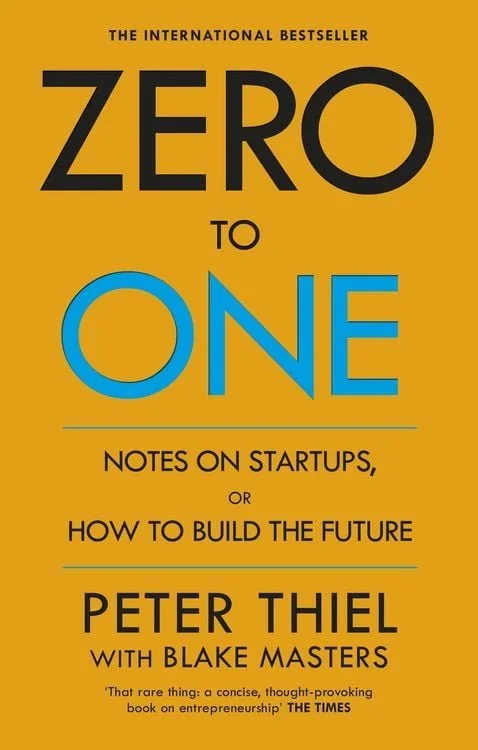
Zero to One – Building What Others Can’t Copy
In business, most companies compete.
Very few truly create.
“Zero to One” by Peter Thiel and Blake Masters is not just another startup book. It is a sharp, provocative framework for thinking differently about innovation, strategy, and value creation. While many business books focus on how to improve existing processes, Thiel asks a more fundamental question:
What can you build that nobody else is building?
For leaders in Lean Management, Operational Excellence, and business transformation, this book creates a powerful tension. Lean teaches us to eliminate waste, improve flow, and optimize systems. “Zero to One” reminds us that optimization alone is not enough if we are optimizing the wrong business model, product, or market position.
Efficiency scales what already exists. Innovation creates what should exist.
Peter Thiel, co-founder of PayPal, early investor in Facebook, and founder of Palantir, brings a deeply contrarian perspective to entrepreneurship and strategy. Blake Masters, who originally documented Thiel’s Stanford lectures, helped turn these ideas into one of the most influential business books of the modern startup era.
Together, they challenge one of the most common assumptions in business:
Success does not come from competing harder. It comes from becoming meaningfully different.
Key Takeaways
From Zero to One vs. One to N:
Going from one to N means copying, scaling, and improving what already exists. Going from zero to one means creating something new. Most companies focus on replication. Great companies create new value.
Competition Is Not Always Good:
Thiel argues that intense competition often destroys profits, reduces differentiation, and forces companies into similarity. The best businesses avoid direct competition by building something unique.
Monopoly Through Differentiation:
A strong business does not start by serving everyone. It starts by dominating a small, clearly defined market and expanding from there. Niche first. Scale second.
Secrets Matter:
Breakthrough businesses are built on insights that others either overlook or reject. A powerful question from the book is: What important truth do very few people agree with you on?
Technology Must Create Real Advantage:
Innovation is not about being fashionable or digital for the sake of it. Technology must create a significant advantage that competitors cannot easily copy.
The Power Law Drives Outcomes:
A few decisions, products, markets, hires, or investments often create most of the results. Not everything matters equally. Focus beats activity.
Sales and Distribution Are Critical:
A great product does not sell itself. Distribution, positioning, marketing, and sales are just as important as product development.
Start Small and Own the Market:
Trying to capture a huge market from day one often leads to weak positioning. The better approach is to start with a small market, dominate it, and then expand deliberately.
Culture Shapes Execution:
Strong companies are built by strong teams. Clear missions, trust, alignment, and complementary skills are essential for turning strategic ideas into operational reality.
Innovation Comes Before Optimization:
Lean can make a system faster, better, and more efficient. But “Zero to One” reminds us that the first question must always be: Is this the right system, product, or business model to optimize?
How you can use these insights to boost your work
Separate innovation work from optimization work. Do not expect the same process that improves today’s operations to automatically create tomorrow’s breakthrough business model.
Ask your team where you are merely competing and where you are truly different. If your value proposition sounds exactly like your competitors’, efficiency will not save you.
Define a niche before trying to scale. Operational Excellence becomes far more powerful when it supports a clear strategic position.
Use Lean thinking after strategic clarity has been achieved. First decide what should be built, then improve how it is built, delivered, and scaled.
Identify the few high-impact decisions that will drive most of your results. Apply Pareto thinking not only to processes, but also to strategy, product development, hiring, and market selection.
Build distribution early. Do not treat sales, marketing, and customer acquisition as afterthoughts. Even the best operational system fails if the market does not understand or adopt the product.
Encourage contrarian thinking in your organization. Many improvement cultures reward alignment, but innovation often begins with uncomfortable questions.
Create protected space for “zero to one” work. Breakthrough ideas rarely survive inside systems designed only for efficiency, standardization, and short-term output.
Use Operational Excellence to scale what is already proven. Once the business has found something unique and valuable, Lean principles can help make it repeatable, reliable, and scalable.
Keep asking one essential question: Are we becoming more efficient, or are we becoming more valuable?
Final Thoughts
“Zero to One” is more than a startup book. It is a strategy book for anyone who wants to build something that cannot easily be copied.
For Lean and Operational Excellence leaders, the book offers an important warning: continuous improvement without strategic differentiation can lead to perfectly optimized irrelevance.
The strongest organizations combine both dimensions:
Strategy creates the unique value.
Operations scales it.
Lean Management helps companies move from one to N.
“Zero to One” challenges leaders to first discover the zero to one opportunity worth scaling.
If you want to move beyond process improvement and think more deeply about innovation, differentiation, and long-term strategic advantage, this book belongs on your reading list.