How it works
- 02 Setup: area, working days, shifts, net minutes per shift, the utilization factor, the program, the rates and the allowances.
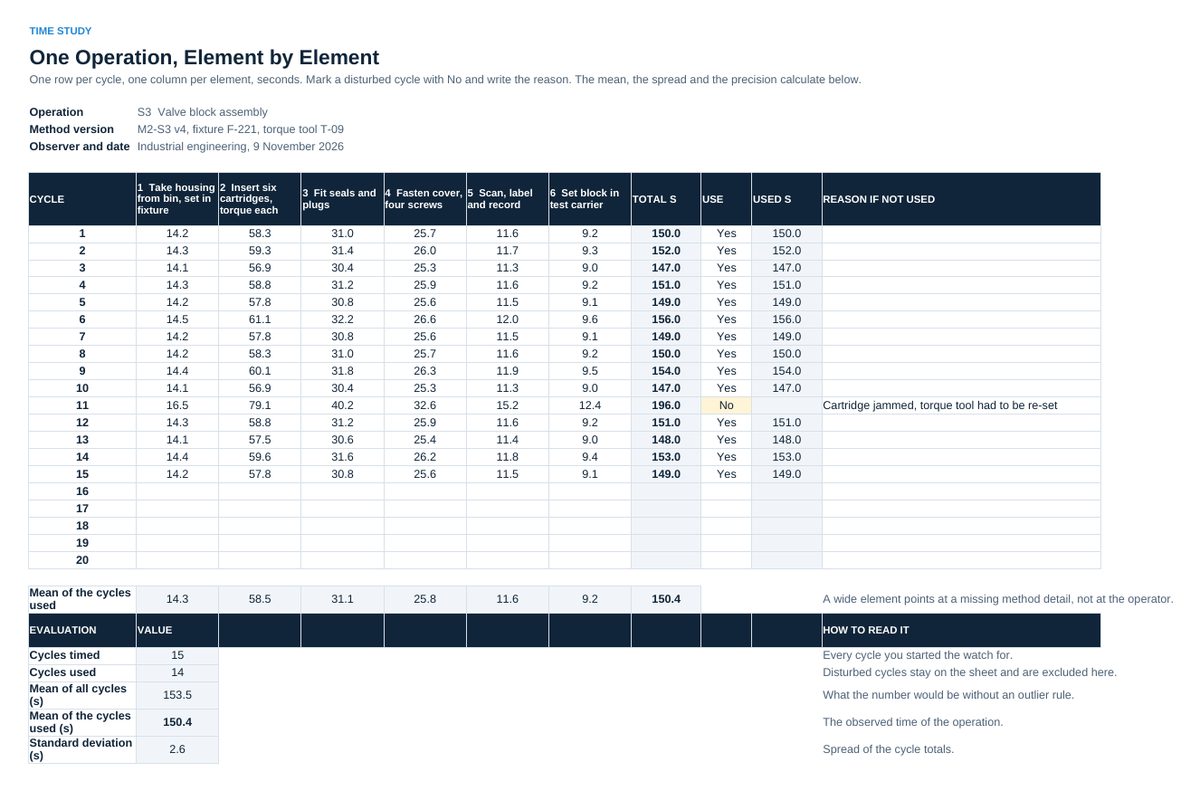
- 03 Time Study: one row per cycle, one column per element, in seconds. Mark a disturbed cycle with No and write the reason. Read the mean, the spread and the precision below the grid.
- 04 Allowances: rate the conditions of the workplace, read the suggested allowances and build the standard time with the machine time and the setup share.
- 05 Standard Times: one row per station or operation, with source, measurement date, review date and status.
- 06 Capacity: the load of every station against the program, the bottleneck, the area capacity and the takt check.
- 07 Status every month at the board.
Definitions used in the workbook
- Observed time: What the watch showed for the defined operation, averaged over the cycles you used.
- Rating: The observed pace compared with a written reference pace. The reference is 100.
- Basic time: Observed time times rating divided by 100.
- Standard time: Basic time plus allowances, plus machine time and the setup share per unit.
- Utilization factor: The share of the planned operating time that is actually available for standard-time work. Measure it, do not assume it.
Sheets in the workbook
- Start
- Setup
- Time Study
- Allowances
- Standard Times
- Capacity
- Status
Who it is for
Industrial engineers, supervisors and planners who need a standard time they can defend and the capacity that follows from it.
The method behind the numbers
This workbook is part of the Work Measurement and Capacity toolkits. The Starter Kit adds the guide and the checklist for the first 30 days. The Excellence Bundle adds playbook, workshop pack, templates, deck and the complete Excel system.