How it works
- 02 Setup: area, time, program, rates and allowances. Every other sheet calculates from here.
- 03 Time Study and 04 Allowances: one operation from the first cycle to the released standard time.
- 05 Work Sampling: the shares of the day and the utilization factor that capacity planning needs.
- 06 Register: every operation with source, method version, measurement date, review date and status.
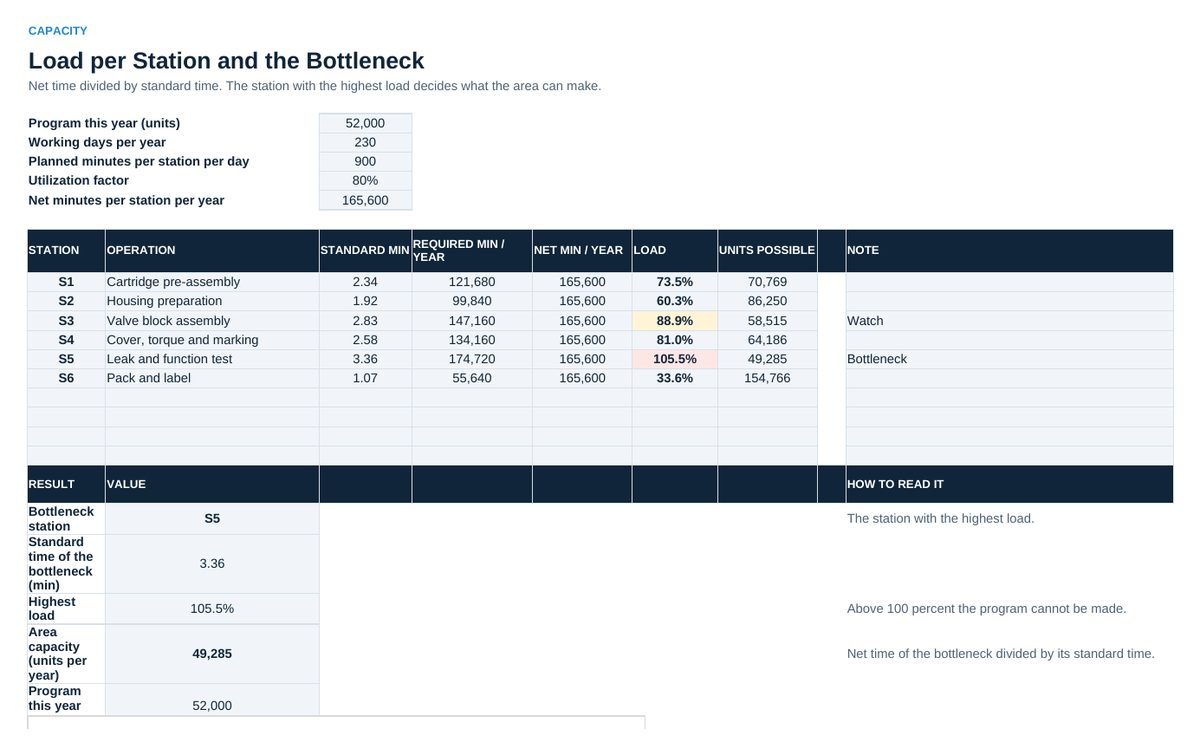
- 07 Capacity, 08 Bottleneck and 09 Scenarios: load per station, the options for the constraint, three programs.
- 10 Plan against Actual and 11 Key Figures: coverage per station and the six numbers for the monthly review.
- 12 Business Case, 13 Audit every six months, 14 Status every month at the board.
Definitions used in the workbook
- Basic time: Observed time times rating divided by 100.
- Standard time: Basic time plus allowances, plus machine time and the setup share per unit.
- Utilization factor: The share of the planned operating time available for standard-time work. Measured, not assumed.
- Load: Required minutes divided by net minutes, per station.
- Time coverage: Standard hours earned divided by hours booked.
Sheets in the workbook
- Start
- Setup
- Time Study
- Allowances
- Work Sampling
- Register
- Capacity
- Bottleneck
- Scenarios
- Plan against Actual
- Key Figures
- Business Case
- Audit
- Status
Who it is for
Industrial engineering and operations managers who maintain the times of a plant and have to say what an area can make.
The method behind the numbers
This workbook is part of the Work Measurement and Capacity toolkits. The Starter Kit adds the guide and the checklist for the first 30 days. The Excellence Bundle adds playbook, workshop pack, templates, deck and the complete Excel system.